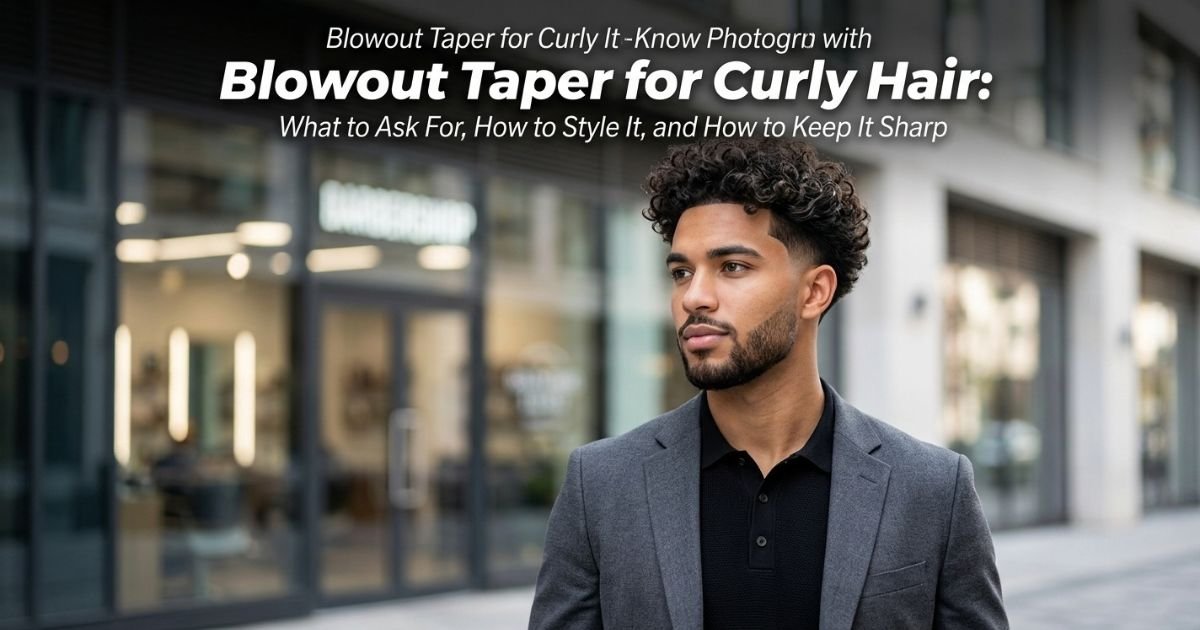
Blowout Taper for Curly Hair: Proven Tips for a Perfect Cut
A blowout taper is a no-brainer gone awry. You request volume at the top and a clean taper on the sides; the barber cuts them wet, and by the time they dry, you are an inch or two shorter than you had envisioned.
This Blowout Taper for Curly Hair guide resolves that. You’ll discover exactly what the cut is, what taper height is right for your curls, the words to use in the chair, and how to style it at home without frizz. There’s also a chapter that deals with the silent killers: mistakes.
What Is a Blowout Taper and How Is It Different From a Fade?
There are two components to a blowout taper. The sides and the neckline taper gradually, and the top remains long and voluminous. The ‘blowout’ is not the sides, but the top.
Taper and fade are often confused. A taper is a gradual decrease in the length of hair, but it typically does not go down to bare skin. A fade fades down to the skin, which makes the contrast more noticeable and the grow-out more visible.
| Taper | Fade | Blowout Taper | |
|---|---|---|---|
| Sides | Gradual, soft edge | Down to skin | Tapered, usually not skin |
| Contrast | Subtle | High | Moderate to high |
| Grow-out | Gentle | Visible line appears fast | Depends on height |
| Top | Any length | Any length | Long, styled for lift |
The wording matters at the barbershop. If you say “blowout fade” and mean a soft taper, you may get skin showing at the temples. Say “taper” if you want length left at the edges.
Curly hair suits this cut well because the curl does the lifting. Straight hair needs a round brush and plenty of effort to stand up, while curls and coils already have volume built in.
What Does a Blowout Taper Look Like on Curly Hair?
The same cut looks different on loose curls and tight coils. Both work, but the finish and the technique change.
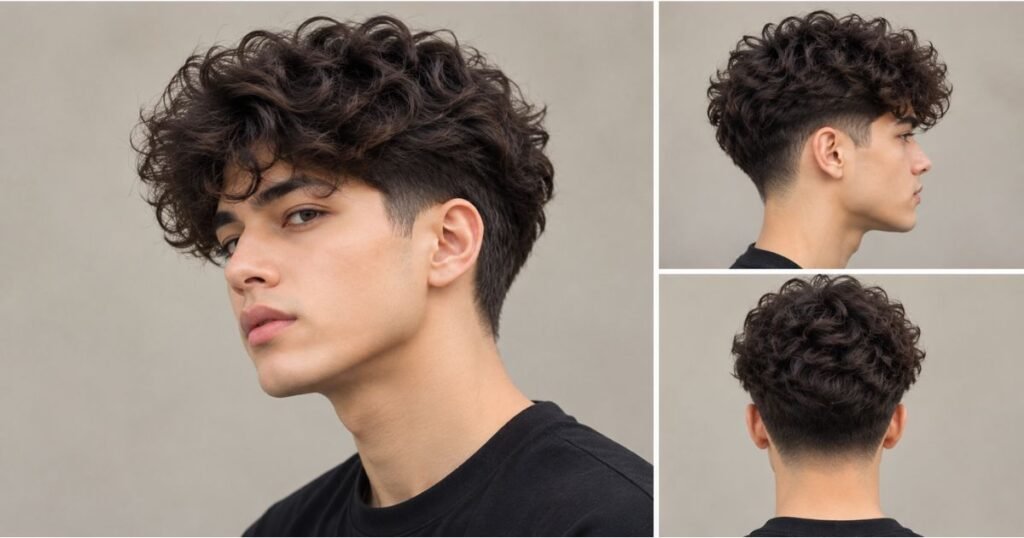
Type 3 Curls (3a, 3b, 3c)
On Type 3 hair, the top reads as bouncy, defined curls sitting above a clean taper. The curl softens the line where the taper meets the top, so low and mid tapers blend in nicely.
Because ringlets spring back, the length on top is easier to predict than on tighter textures. The tradeoff is that curl definition is the whole point here. If the curls frizz or clump unevenly, the cut loses its shape fast.
Type 4 Coils (4a, 4b, 4c)
On Type 4 hair, the top usually looks like a rounded, shaped afro instead of separate rings. The density also makes the taper line look crisper, since coiled hair at the sides is thick and opaque.
A lot of men with 4c hair bring in photos of loose curls and get disappointed. The honest expectation is a clean, sculpted silhouette, and it helps to show your barber a photo of someone with a similar texture.
Low, Mid or High: Which Taper Height Suits Curly Hair?
Taper height controls how much contrast you get and how often you’ll need a cleanup. Curl softens the transition at every height, so you can go a little bolder than you could with straight hair.
| Height | Starts | Look | Cleanup Every | Best For |
|---|---|---|---|---|
| Low | Just above the ear | Soft, natural | 3 to 4 weeks | First-timers, low upkeep |
| Mid | Around ear or temple level | Balanced contrast | 2 to 3 weeks | Most curl types |
| High | Above the temple | Bold, sharp | 1 to 2 weeks | Defined curls, frequent barber visits |
If you can only choose one, a mid taper is the safest pick. It shows clear contrast without demanding weekly visits. For a deeper look at that height, our guide to the mid blowout taper breaks down who it suits and how to maintain it.
Does Head Shape Change the Best Height?
It does, a little. A flatter crown tends to look better with a mid or high taper because the contrast draws the eye up. A low taper on a flat crown can make the head look wider.
Tell your barber about your crown directly. Something like “I want to keep weight at the crown” protects the volume you’re counting on.
Cowlicks and Density Matter Too
Most guides will overlook two things: cowlicks and density. Curls can go in strange directions if there is a strong cowlick at the crown or front of the head; a barber who is aware of this will cut against it rather than with it.
Thick, dense hair maintains the taper shape, but may be boxy. Finer curls should be tapered less aggressively, as the top sides are not as sparse as they would be with a more aggressive taper.
What Exactly Should You Tell Your Barber?
Give your barber a taper height, a top length measured with the hair stretched, and a request to cut the top dry. Those three details prevent most disappointing results.
The Shrinkage Problem and the Stretched-Length Test
Curly hair shrinks as it dries, and tight coils can lose more than half their visible length. So “three inches” means something very different on wet hair versus dry hair.
Here’s a quick way to get your number before you go:
- Pick a curl near your crown on dry hair.
- Gently pull it straight down without straining it.
- Measure from scalp to tip. Give your barber that stretched number and explain that your curls will sit shorter.
Shrinkage also changes with weather. Humid days make curls spring tighter, so don’t judge your length on a single day.
Barber Scripts You Can Screenshot
Type 3, low taper: “I want a low taper blowout on curly hair. Start the taper just above my ear, clean neckline and sideburns. Leave the top about [X] inches stretched. Please cut the top dry and point-cut it, not blunt.”
Type 3, mid taper: “Mid taper starting at ear level with tight, clean edges. Keep [X] inches stretched on top. I have shrinkage, so please don’t measure wet. Point-cut for texture.”
Type 4, low taper: “Low taper with a full, rounded top. Keep the weight at the crown and don’t thin the top. My hair shrinks a lot, so cut it dry or stretched. Sharp line-up at the front.”
Questions to Ask Before You Sit Down
Not every barber is used to curls. A quick check saves you a bad haircut:
- Do they have photos of taper cuts on curly or coily hair in their portfolio?
- Do they cut curly tops dry?
- Do they point-cut, or do they blunt-cut everything?
If the answer to the second question is “no,” book somewhere else. It’s the biggest predictor of how the cut turns out.
Show Up With Hair They Can Actually Read
Arrive with clean, dry, product-free curls, ideally on a normal hair day. Heavy product hides the real pattern, and flat or slept-on hair makes it harder to judge where the weight sits.
How Should a Barber Cut Curly Hair for This Style?
Curly hair needs a different technique than straight hair. The two biggest differences are point cutting and dry cutting.
| Technique | What Happens | Result on Curls |
|---|---|---|
| Point cutting | Scissors angled into the hair, cutting strands at different lengths | Removes bulk; curls separate and lift |
| Blunt cutting | Scissors held flat, all strands cut at one length | Curls puff outward and look heavy |
A blunt cut is the usual culprit when curls “poof” sideways instead of rising. Point cutting removes the same length but lets the curl move.
Watch Out for Thinning Shears
Some barbers reach for thinning shears to reduce bulk. On curly hair, this often backfires, since it creates short, frizzy strands that stick out from the curl. If your hair feels heavy, ask for point cutting first.
The Line-Up and Edge Enhancement
On dark, coily hair, many barbers use a line-up and sometimes a hair-fiber or enhancement product at the edges to make the taper look crisper. It’s often an add-on, so ask about the price before the service starts.
Explore More: Classic Taper Haircut: What It Is, Who It Suits and How to Ask for It
How Do You Style a Blowout Taper at Home?
Styling comes down to moisture, definition, and gentle drying. The routine differs a bit for loose curls and tight coils.
Type 3 Routine
- Wash with a sulfate-free shampoo or co-wash.
- Apply a leave-in or curl cream to soaking wet hair.
- Add a light mousse for hold.
- Diffuse on low heat with medium airflow, holding the diffuser against your scalp.
- Scrunch gently upward and let hair dry mostly before moving on.
- Finish with cool air, then separate clumps lightly.
The most useful habit here is keeping your hands out of your hair while it dries. Touching curls mid-dry breaks up the clumps and creates frizz.
Type 4 Routine
- Wash with a moisturizing shampoo.
- Apply leave-in conditioner to wet hair right away.
- Layer a curl activator or light gel for definition.
- Diffuse on low heat until mostly dry.
- Shape the top with an afro pick at the roots, lifting rather than combing through.
- Smooth the silhouette with a curl sponge if you want a tidier outline.
How to Refresh Day 2 and Day 3
You don’t need to rewash every day. A quick refresh brings back most of the shape.
| Step | Type 3 | Type 4 |
|---|---|---|
| Rehydrate | Light water mist | Water and leave-in mist |
| Product | Small amount of curl cream on ends | Light curl activator at roots and mid-shaft |
| Reshape | Scrunch upward | Lift roots with a pick |
| Dry | Air dry or short low-heat diffuse | Air dry or brief diffuse |
A satin pillowcase cuts down friction overnight, and loosely gathering the top of your hair on Type 3 helps keep the crown from flattening.
What Products Work for a Blowout Taper on Curly Hair?
Match products to your texture. What defines looser curls can sit on top of tight coils without absorbing.
| Need | Type 3 | Type 4 |
|---|---|---|
| Moisture | Curl cream | Leave-in conditioner |
| Definition | Light mousse or gel | Curl activator |
| Heat protection | Spray protectant | Cream or spray protectant |
| Tools | Diffuser | Diffuser, pick, sponge |
Heavy waxes and hard gels are the usual troublemakers. They leave a stiff cast that cracks when you scrunch it out, and wax builds up on the strand over time. A clarifying wash once or twice a month clears the residue.
How Long Does a Blowout Taper Last?
A blowout taper usually looks sharp for two to four weeks, depending on height and texture. Hair grows about half an inch a month on average, whatever your curl type, but the taper line shows regrowth at different speeds.
| Height | Looks Grown Out | Cleanup | Full Cut |
|---|---|---|---|
| Low | 3 to 4 weeks | Every 3 to 4 weeks | Every 4 to 5 weeks |
| Mid | 2 to 3 weeks | Every 2 to 3 weeks | Every 3 to 4 weeks |
| High | 1 to 2 weeks | Every 1 to 2 weeks | Every 3 weeks |
Coily hair often hides a low taper’s regrowth better than looser curls, because the dense texture blurs the line. That makes a low blowout taper a practical starting point if you don’t want constant appointments.
First Time Getting One? Mistakes to Avoid
If this is your first blowout taper, start with a mid taper. It looks clear without the upkeep of a high one and grows out gracefully if you change your mind.
Bring two photos: one of the side for taper height, one of the front for top shape. Pictures remove most of the guesswork.
A few mistakes come up again and again:
- Giving a wet length. Always give a stretched or dry length.
- Starting with a high taper. It needs trims every one to two weeks, which catches first-timers off guard.
- Skipping heat protection. Diffusing without it dries out the ends and weakens definition over time.
- Using the wrong product for your texture. Copy the routine for your curl type, not the one in the photo.
- Letting the barber thin the top. Ask for point cutting instead.
Conclusion
Communication is the main factor for a good blow-out taper for curly hair. Choose a length that you can keep and supply your barber with a stretched length rather than a wet one, and request point cutting on top.
Once that is mastered, stick with the same routine. No shelf full of products will get you any further than moisture, a light-handed definer, and a diffuser on low heat. With two photos and your stretched number, you’ll leave with the cut you envisioned at your first appointment.
FAQS About Blowout Taper for Curly Hair
Can you get a blowout taper with curly hair?
Yes. Curly and coily hair already carries natural volume, so the taper just cleans up the sides and neckline. The key is asking for a dry cut and point cutting on top.
What is the best taper height for curly hair?
Yes. Curly and coily hair already carries natural volume, so the taper just cleans up the sides and neckline. The key is asking for a dry cut and point cutting on top.
How do I stop my curly blowout taper from looking flat?
Cut the top with enough length, use a diffuser on low heat, and avoid heavy gels and waxes. On day two, mist lightly and reshape the roots instead of piling on more product.